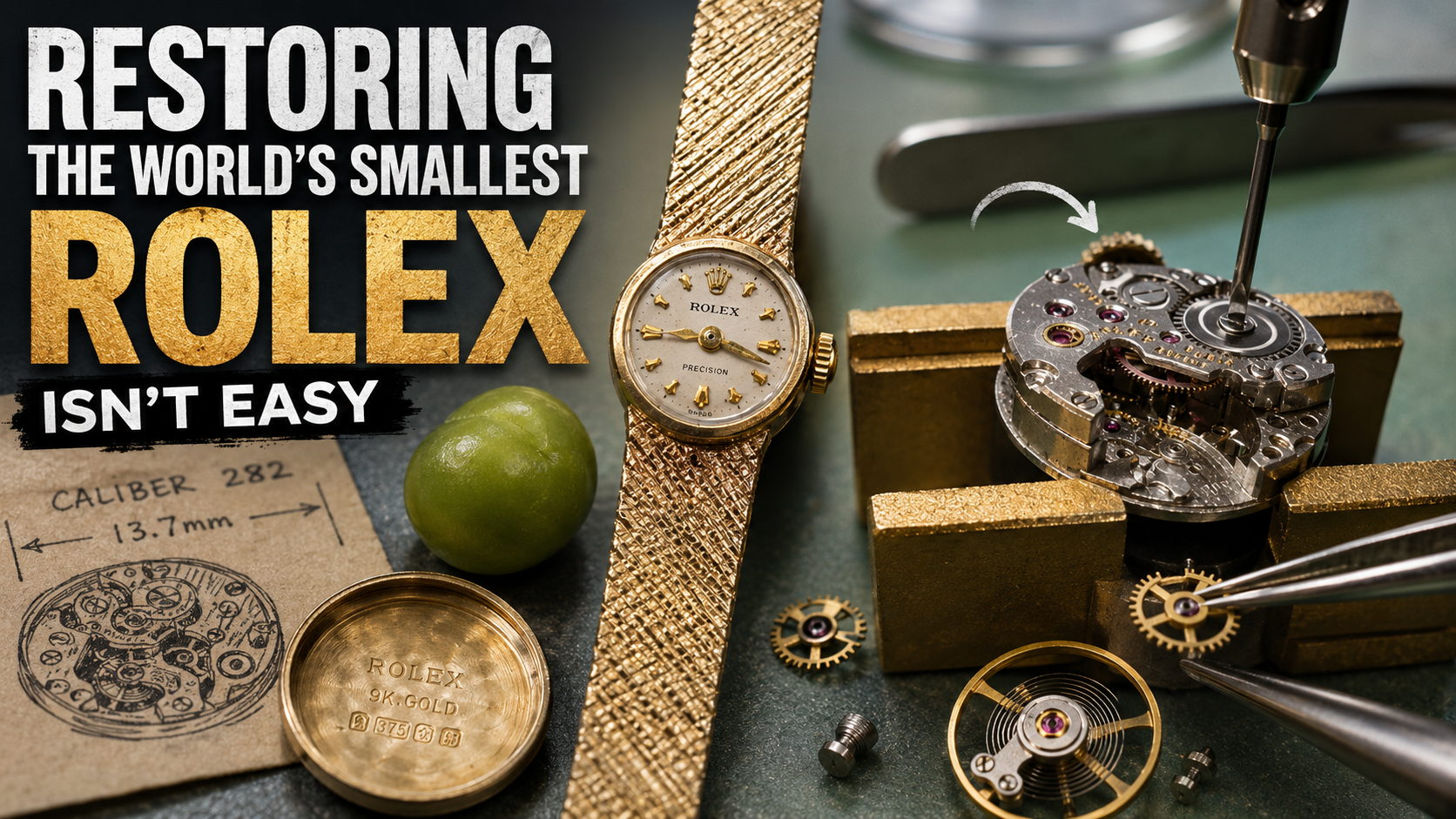
This Rolex is smaller than a pea. And it came loaded with problems that almost ended the whole restoration before it began.
Bought for just £400, this tiny 9-karat gold Rolex looked simple enough. Next, I started bringing it back to life.
The mainspring was snapped. The keyless works was damaged. And once the case was opened up, the watchmaker found himself staring at a caliber 282, one of the smallest Rolex movements ever built, at just 13.7mm across. It only loses the title of smallest by a hair to its successor, the 1400 series.
Here’s the twist. This tiny “Rolex” movement is actually built on a Felsa design, a smaller Swiss manufacturer that Rolex quietly used and rebranded in its early decades. So when the watchmaker needed an impossible-to-find part, he didn’t search for Rolex spares. He searched his old stash of Felsa, A. Schild, and FHF parts instead, and found exactly what he needed.
But that was only the start. A cracked escape wheel had to be replaced entirely. The replacement mainspring didn’t fit the barrel, so it had to be coiled in by hand using pure patience and tiny tools. Then a loose jewel setting turned up, with a bridge hole worn so wide the whole shock-absorbing unit could be pushed out with a finger. That meant carefully shrinking the metal back down with a staking set, without cracking anything in the process.
Even after all that, the balance still wouldn’t swing properly. The fix? A shim slipped underneath, the same trick top watchmaking brands quietly use themselves.
Along the way, there’s a fun detour into the actual smallest watch movement ever made, Jaeger-LeCoultre’s caliber 101. At just 4.8mm wide with 98 parts, it’s the movement Queen Elizabeth II wore at her 1953 coronation, and JLC still makes it today for over £180,000.
After all the repairs, the cleaning, and a careful polish of the gold case and bracelet, this pea-sized Rolex goes from a £400 basket case to a piece worth close to £3,000.
Watch the full restoration here: