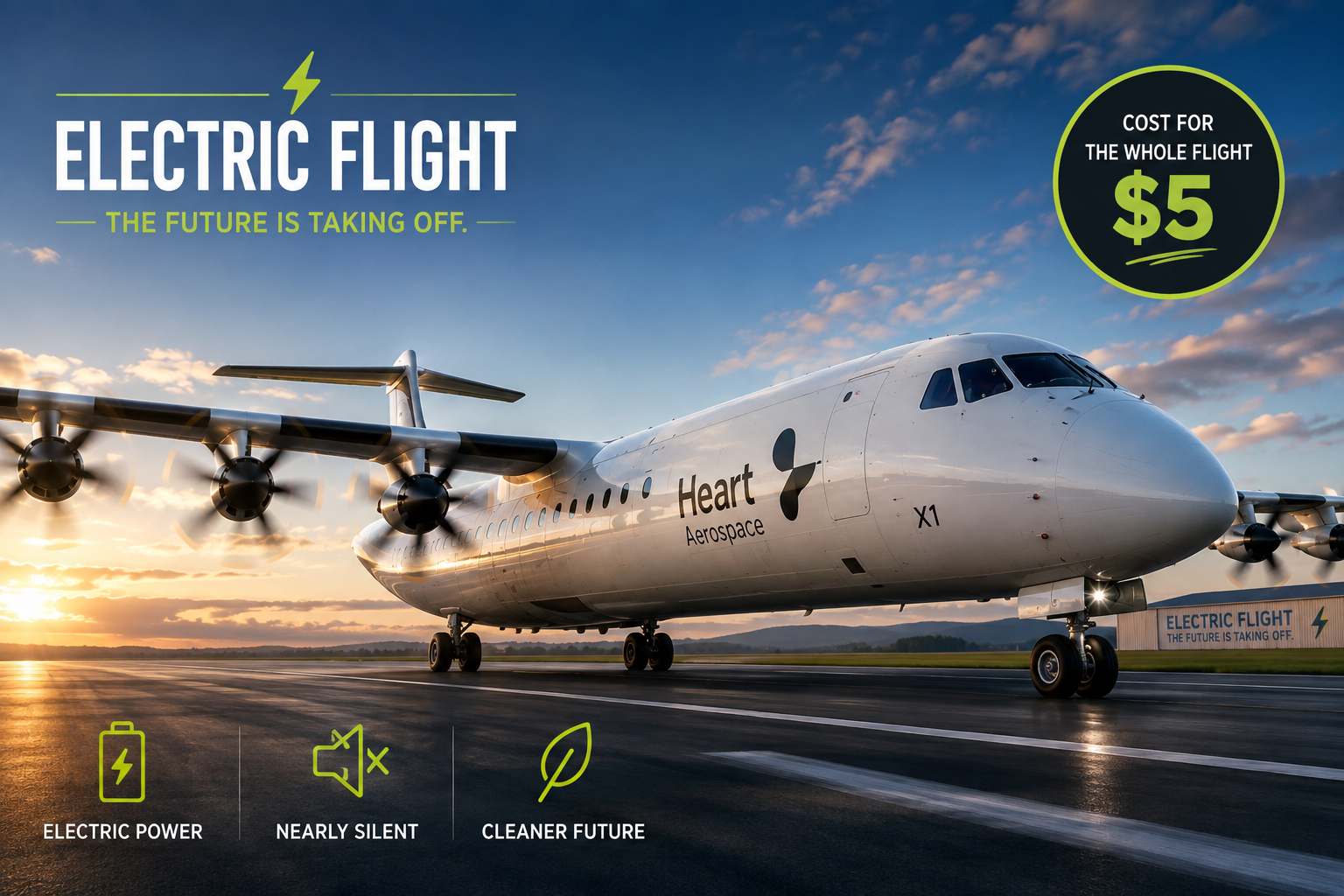
What if your next flight cost just $5?
That’s not a typo. Heart Aerospace just flew the world’s largest electric aircraft, and the electricity bill for the whole flight was literally five dollars.
The plane is called the X1. It has a 106-foot wingspan, weighs over 25,000 lbs, and runs on eight battery packs sitting right on the floor of the fuselage. Instead of thousands of jet engine parts burning fuel hot enough to melt metal, it uses electric motors with essentially one moving part.
No combustion. Near-zero wear. Almost silent at 100 feet away.
And the man behind it started with a 3D-printed model he could hold in his hand.
Anders Forslund walked into Y Combinator 7 years ago with that tiny plastic plane and letters of intent from Scandinavian Airlines. United Airlines first reached out through the spam folder. Today, Heart Aerospace has actual pre-orders, FAA authorization, and a completed first flight over Plattsburgh, New York.
The timing is not a coincidence. Half of all flights in the world are under two hours. The regional planes serving those routes are 40-year-old designs. Jet engines are brutally inefficient on short hops, burning 10% of their fuel just taxiing to the runway. Heart’s aircraft flips that whole equation.
The production model, the ES-30, will carry 30 passengers up to 125 miles on battery alone and extend to roughly 400 km as a hybrid. It recharges in about 30 minutes. It fits into airports that already exist. And because electric motors are so much cheaper to maintain, Heart projects operating economics that beat today’s regional jets by nearly 50%.
This is not a flying taxi. This is not a drone concept. This is a commercial airliner, the first one built in the United States in 18 years.
Watch the full story of how they pulled it off, from a spam-folder email to a 100-foot wingspan hurtling down the runway, right here.