How camels turn the harshest place on Earth into a playground
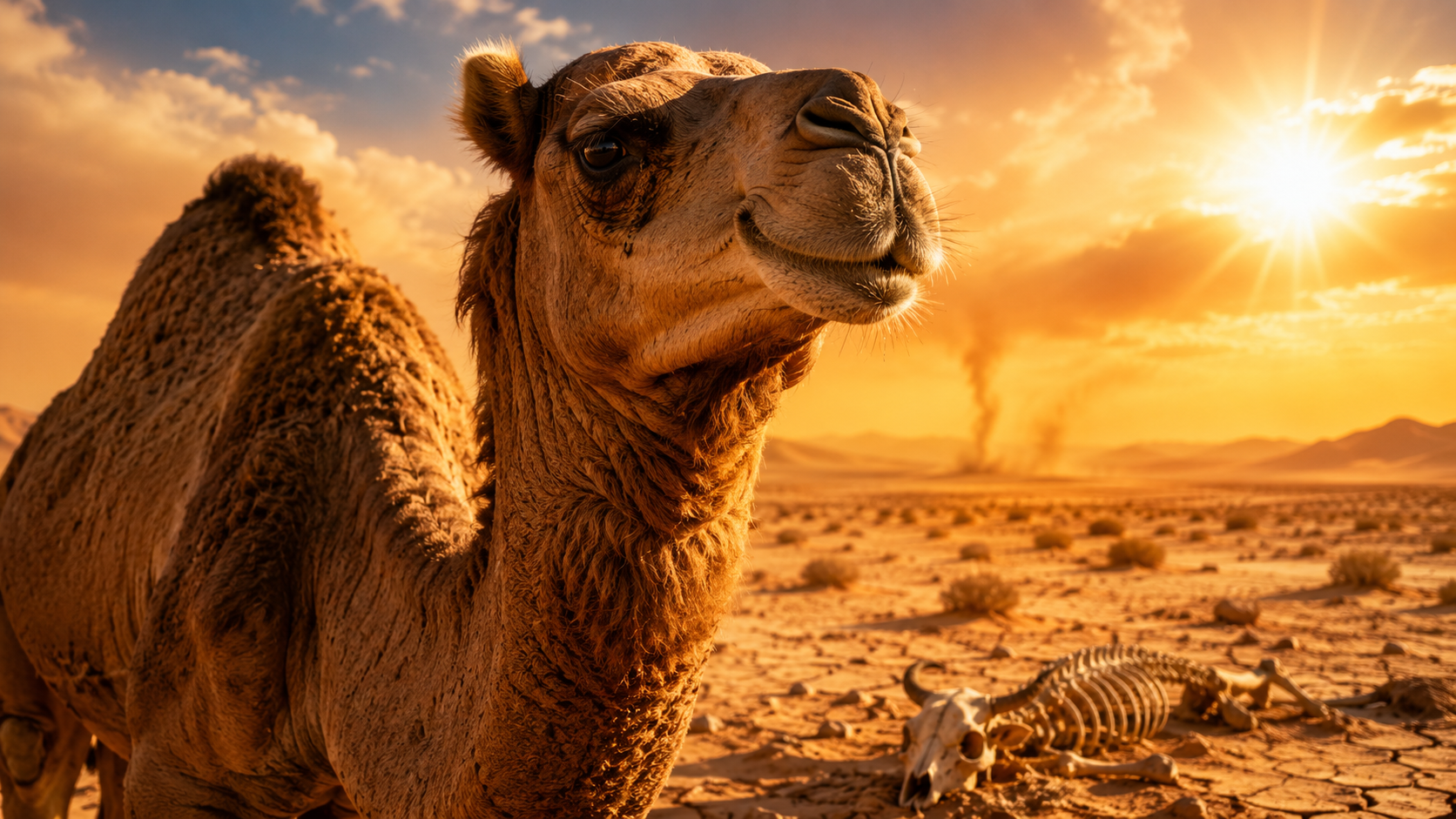
Picture a day in the Sahara so hot it makes tires explode. Every living thing is dead, dying, or hiding underground, except one animal, just standing there, not sweating, not panting, completely unbothered.
Everything you think you know about that animal is probably wrong.
Camels did not evolve in the desert. They started in North America about 50 million years ago, looking more like a beagle than the giant humped icon we know today. It was only millions of years later, after a slow migration across the Bering land bridge, that some headed to Asia and became camels while others went to South America and became llamas and alpacas.
And the hump? It is not a water tank. It is pure fat, up to 80 pounds of it. That fat packs more energy per gram than carbs or protein, breaks down into water when metabolized, and keeps insulation off the rest of the body so the camel does not overheat.
The rest of the camel is just as strange. Their blood cells are oval, not round, so they can keep flowing even when dehydration makes the blood dangerously thick. Their body temperature can legally swing by 6°C a day, which would kill a human, so that they can delay sweating and save water. Their nostrils recycle up to 60% of the moisture from every breath. Their spit is basically a stomach acid weapon.
They can drink 30 gallons of water in one sitting without going into shock. They can lose 30% of their body weight in water and keep walking, while most mammals die at 15%.
Camels also quietly reshaped human history. They carried the Silk Road. They terrified horses on ancient battlefields. Their milk has three times as much vitamin C as cow’s milk and has kept desert communities alive for generations.
Today, domestic camels number over 35 million worldwide, while their closest wild relatives, the wild Bactrian camels of the Gobi Desert, are down to fewer than 1,000. Meanwhile, a batch introduced to Australia in the 1840s went feral and multiplied into over a million animals, becoming an entirely different kind of problem.
Camels are not majestic. They are not graceful. They will absolutely try to bite your face off. But when it comes to sheer, rule-breaking survival, nothing else comes close.
Watch the full video here to see just how deep the weirdness goes: