No blueprints. No wheels. No explanation left behind.
4,600 years ago, someone stacked 2.3 million stone blocks into a perfect mountain in the desert.
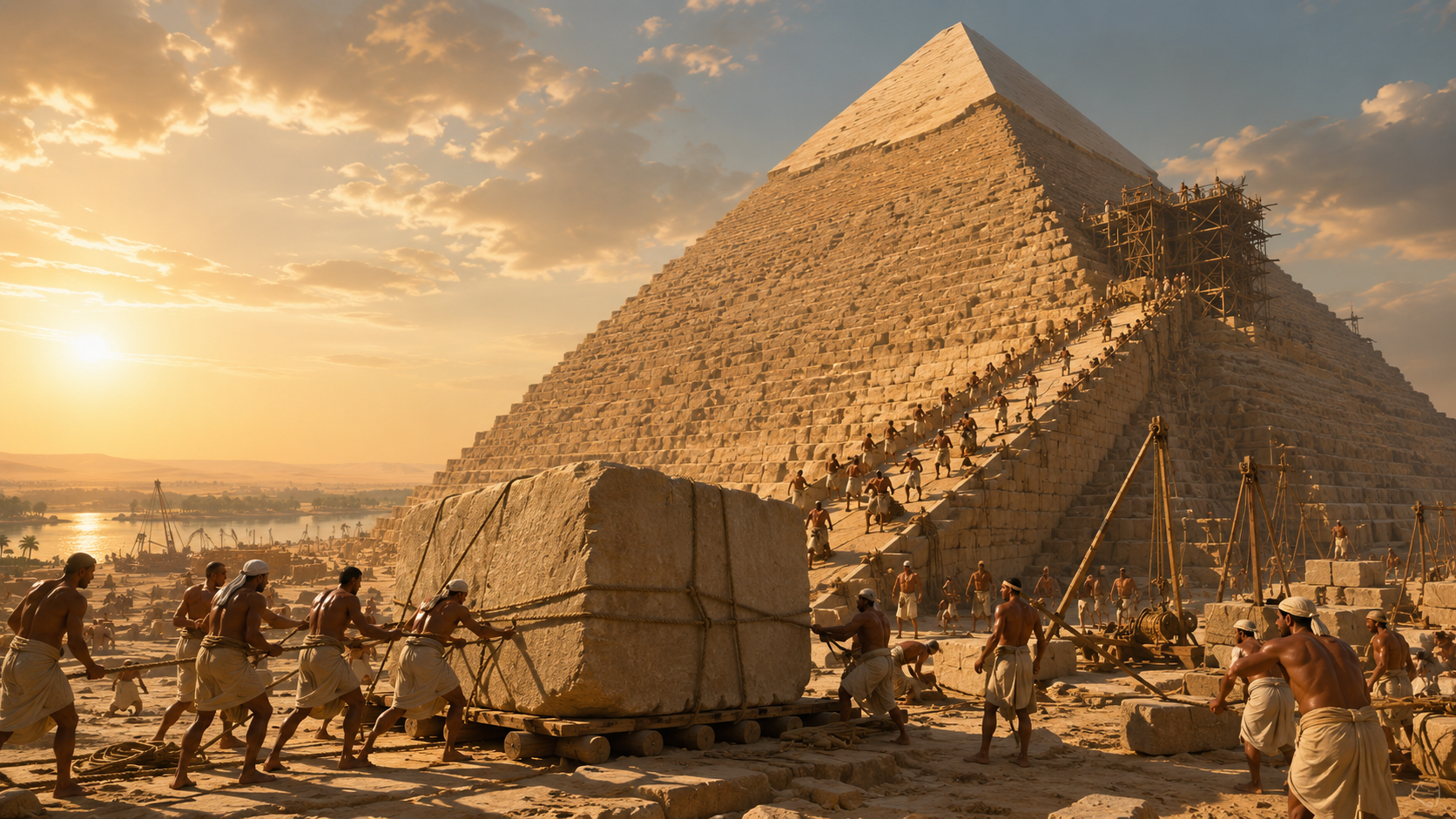
The Great Pyramid was built for the pharaoh Khufu in about 20 years, using an estimated 25,000 workers. Its base is almost perfectly level and lined up with the compass points, centuries before the compass existed.
So how did they actually do it?
Theory one is the classic answer: a giant external ramp dragging stones up a slope. Simple, but the math breaks down fast. A ramp gentle enough for workers to climb would need to be over a kilometer long and use more material than the pyramid itself.
Theory two comes from French engineer Jean-Pierre Houdin. He argues for a hidden internal spiral ramp built inside the pyramid, plus a wild theory that the Grand Gallery worked like a giant counterweight system, using rolling carts to help haul 50-ton granite beams up to the King’s Chamber.
Theory three is the newest and strangest. A 2024 study suggests a lost branch of the Nile ran right next to the pyramid, and that builders may have used a water-powered elevator, floating heavy stones upward on a wooden platform inside a hidden shaft.
None of these theories has won the debate. And in 2017, physicists found a massive unexplained void deep inside the pyramid using particle physics, one more mystery still waiting to be solved.
We break down all three theories, the evidence for and against each one, and what that hidden void might actually be. Watch the full video here: